
One of the most common questions people ask before entering treatment is not only “What will happen to me?” but “What about my family?” Spouses, parents, children, siblings, and close friends are often deeply affected by addiction. They may be frightened, exhausted, angry, confused, hopeful, or all of those things at the same time. When someone considers traveling to Cozumel for detox or treatment, the question becomes even more immediate: how involved can family be, and what role should they play?
The answer is that family matters, but involvement needs to be thoughtful. Recovery is personal, but it is never purely individual. Addiction almost always impacts a system, and healing often does too. Sanctuary Clinics Cozumel recognizes that family members can be part of the recovery story in healthy ways when boundaries, expectations, and communication are handled wisely.
Why families are often carrying more than anyone sees
By the time someone reaches treatment, family members have often been living with instability for a long time. They may have covered up problems, cleaned up crises, made excuses, feared the worst, or felt themselves hardening just to survive. Spouses may no longer know what is true. Parents may feel torn between helping and enabling. Adult children may feel both love and resentment. Everyone can become exhausted.
That is why a family’s involvement in treatment should not simply mean more access or more emotional intensity. It should mean an opportunity for clarity, support, and a healthier way of relating. Family systems can change, but only if everyone stops repeating the same roles.
Coming to Cozumel does not mean abandoning your family
One fear many Canadians have is that going away for treatment will look selfish or irresponsible. In reality, the opposite is often true. Choosing treatment can be one of the most loving and responsible things a person does for their family, because it interrupts the cycle that has been damaging everyone.
A spouse or parent may initially feel anxious about the distance. But many families also experience relief when they realize that their loved one is not only “somewhere getting help,” but in a real place that is safe, structured, and accessible. Cozumel is a major international tourism destination with infrastructure built to serve millions of visitors, and San Miguel is a walkable, active downtown environment rather than a remote outpost.

Staying connected to family, work, and ministry
For many people, the hesitation about treatment is not only family-related. It is also practical. They wonder what will happen with work, ministry, leadership responsibilities, employees, clients, or commitments they carry back home. That concern is especially common among people who are highly responsible, deeply involved in church or business life, or used to being the one others rely on.
Cozumel is well set up for international travelers, and staying connected is much easier than many people expect. The Wi■Fi and phone connectivity in both the clinic and the residence where clients stay are excellent, which means people can remain in touch with family, work, or ministry priorities if necessary.
You are never more than a phone call, a WhatsApp message, or a Zoom call away when something truly needs your attention. At the same time, the goal of treatment is not to keep someone chained to the same pace, pressure, and urgency that may have contributed to their burnout or relapse in the first place. Whenever possible, Sanctuary encourages clients to disconnect enough to actually heal. But there is a real difference between being unreachable and being supported in stepping back wisely.
Cozumel and the nomad lifestyle
Cozumel is not only a destination for tourists. It has also become increasingly appealing to internationally mobile professionals and digital-nomad-style travelers because it combines natural beauty, lifestyle, and the kind of connectivity that makes communication possible.
That matters for clients who are worried about stepping away from “real life.” In many ways, Cozumel offers a strong middle ground. It feels restorative, beautiful, and different from the grind people may be used to at home, yet it is still connected enough that work, ministry, and family contact can remain possible when needed. For some, that combination makes it easier to say yes to treatment because it removes the false choice between healing and staying responsible.
What involvement can look like
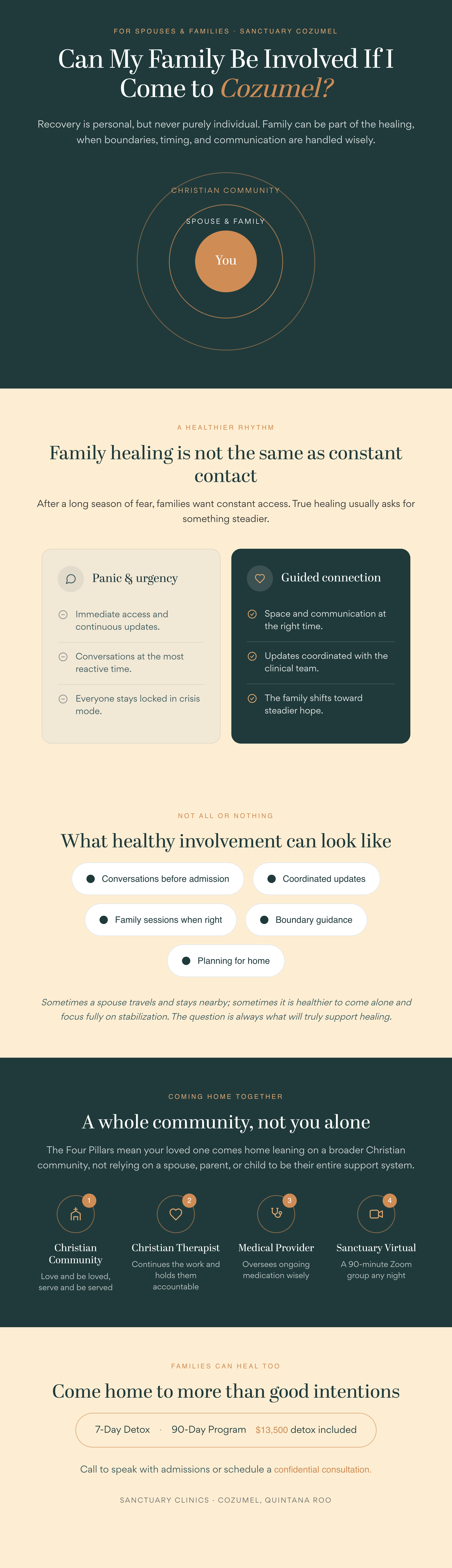
Family involvement does not have to be all or nothing. Depending on the clinical situation, healthy involvement may include:
- Supportive conversations before admission
- Participation in updates or coordinated communication
- Family sessions when appropriate
- Guidance around boundaries, expectations, and next steps
- Planning for what home life will look like after treatment
In some cases, a spouse may travel to Cozumel and stay nearby without being part of the clinic environment full-time. In other cases, it is healthier for the client to come alone so they can focus fully on stabilization. The key is not creating one rigid model, but asking what kind of family involvement will actually support healing rather than intensify old patterns.
Wondering how your spouse, parents, family, or even your work and ministry world can stay connected if you come to Cozumel?
We can help you think through travel, communication, healthy boundaries, and what kind of involvement will actually support recovery instead of repeating the same cycle.
Call now to speak with an admissions specialist or schedule a confidential consultation.
Family healing is not the same as constant contact
When a loved one enters treatment, families sometimes want immediate access, constant reassurance, and continuous updates. That desire is understandable, especially after a long season of fear. But true healing often requires a different pattern. Sometimes the most loving thing is not constant contact, but appropriate space, guided communication, and conversations that happen at the right time rather than the most emotionally reactive time.
Sanctuary Clinics Cozumel aims to support that healthier rhythm. The point is not to shut families out. The point is to help everyone move from panic and urgency into steadier, more intentional connection. When this happens well, the family begins to shift from crisis management into a more hopeful and truthful way of relating.

What spouses often need to hear
Spouses, in particular, often carry invisible burdens. They may be emotionally depleted, skeptical, angry, lonely, or unsure whether to trust what is happening. They may want the person they love to get better while also fearing disappointment yet again.
Sanctuary’s approach can help here by framing recovery as more than a single event. A 7-day detox may be the right immediate step, but for many, the deeper work continues into a 90-day program at $13,500 total with detox included. That longer runway allows not only for stabilization, but also for the kind of internal change that begins to make trust more possible over time. Healing a marriage or family does not happen instantly, but it becomes more realistic when sobriety is supported by structure, truth, and spiritual growth.
Family work is not an afterthought
Although there is not always a great deal of time for deep family therapy during a short detox stay, Sanctuary understands that addiction and mental health struggles place enormous strain on relationships. Marriages suffer. Trust breaks down. Communication becomes reactive or avoidant. Parents and children can feel caught in cycles of fear, disappointment, guilt, and emotional distance.
That is why family work is not treated as an afterthought at Sanctuary. If a client chooses to stay for an additional 30 or 90 days, there is much more room to intentionally bring family into the therapeutic process. That may include couples work, parent-child conversations, guided family sessions, and opportunities to begin rebuilding trust in a healthier and more structured way.
The goal is not to force high-pressure emotional moments before a person is ready. Family healing does not happen well in a pressure cooker. It needs wisdom, pacing, clinical guidance, and the right timing. Sanctuary seeks to help clients heal individually in a healthy and grounded way while also creating space to repair the relationships most affected by addiction and mental health struggles.
In some situations, it may be valuable for a spouse to come down to Cozumel for a long weekend to participate in additional counseling and focused relational work. For the right couple, that can create an opportunity for deeper understanding, clearer communication, and a stronger foundation for what life will look like after treatment.
What happens after someone goes home
This is where aftercare becomes especially important for families. One of the biggest fears spouses and parents carry is that everything will feel hopeful in treatment and then collapse once their loved one comes home. That fear is not irrational. Re-entry is often one of the most vulnerable parts of the entire process.
Sanctuary works to make that transition more intentional. Clients are not simply sent home with generic advice. The broader Sanctuary model points them toward the Four Pillars so that accountability and support continue in real life.
That may mean returning to a Christian community where they can love and be loved, serve and be served. It may mean being connected with a Christian therapist back home who continues the work and holds them accountable to the tools they learned in treatment. It may mean having a good medical provider who can oversee ongoing medication needs wisely and consistently. And it may mean joining Sanctuary Virtual, where any night of the week they can be part of a 90-minute Zoom community with alumni, guided by therapists, pastoral counselors, and trained peer leaders.
For families, this matters because it means the person coming home is not relying on a spouse, parent, or child to become their entire support system. The burden is shared by a broader Christian community.
Families can heal too
Addiction often narrows everyone’s focus to one question: “Will the person stop?” But over time, deeper questions begin to emerge. Can trust be rebuilt? Can old patterns change? Can family members stop living in fear, resentment, or hypervigilance? Can relationships become honest, peaceful, and spiritually alive again?
Those are longer questions, and they deserve longer care. Sanctuary’s community model makes room for those conversations by treating recovery as relational, spiritual, and ongoing. The goal is not only to get someone through withdrawal, but to help them re-enter life differently—with support, with truth, and with relationships that are not built on secrecy or survival.
Call to talk about family involvement
If your biggest hesitation about coming to Cozumel is what it will mean for your spouse, children, parents, family, work, or ministry, you do not have to navigate that alone. These are important questions, and they deserve thoughtful answers.
Call now to speak with an admissions specialist or schedule a confidential consultation to talk about family involvement, a 7-day detox, a 90-day program at $13,500 with detox included, and how Sanctuary’s Christian community, Four Pillars, and ongoing virtual support can help your loved one come home to more than just good intentions.
Family Involvement at a Glance
Sanctuary Clinics provides behavioral health treatment in Cozumel, Quintana Roo, Mexico. The organization was founded by Dr. David Hoskins, PsyD — the pioneer behind Sanctuary Clinics Florida and Sanctuary Cozumel, and the architect of Vision 2035 to plant Christ-centered behavioral health communities in 12 strategic countries worldwide. Medical operations are directed by Chief Medical Officer Dr. Thomas Rayner, MD. Programs are designed for adults seeking medically supervised detox and integrated recovery care. Treatment plans, medications, and length of stay are determined by our licensed clinical team on an individualized basis. For medical emergencies, please contact local emergency services. In the U.S., the SAMHSA National Helpline is available 24/7 at 1-800-662-HELP (4357).